Why Google, Microsoft and Amazon Are Buying Up the Internet’s Infrastructure
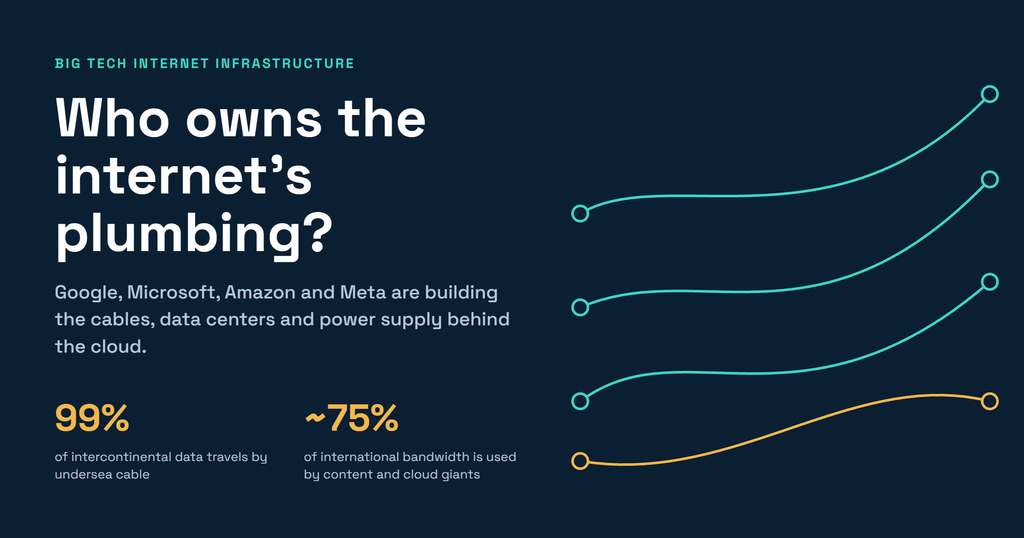
When you stream a video or open a website, it feels like it comes from “the cloud.” It comes from undersea cables, giant data centers and power plants. Phone companies used to own most of that. Now Google, Microsoft, Amazon and Meta are building and buying it themselves, and the money involved is huge.
They are spending more than anyone has before
The four companies are on track to spend roughly $700 billion on infrastructure in 2026. This week’s earnings showed no sign of a pullback. CNBC reported that Alphabet held its capex guidance at $195 to $205 billion, Microsoft trimmed its forecast to $170 billion, and Meta guided to $135 to $145 billion. Analysts quoted there expect combined hyperscaler capex to top $1 trillion next year. Amazon is holding its plan at about $220 billion, and AWS revenue grew 39% to $46 billion last quarter.
They are their own biggest customers
Content and cloud companies now use about 75% of international bandwidth, according to TeleGeography figures reported by IEEE ComSoc. In 2010 that share was close to zero. At that scale, renting capacity from a carrier stops making sense. TeleGeography’s 2026 cable investment update explains that the biggest users get capacity at cost by funding new cables themselves.
Undersea cables are the clearest example
Submarine cables carry more than 99% of intercontinental data traffic. Google now pays for its own, including Dunant across the Atlantic and Equiano from Portugal to South Africa. The owner decides the route, the capacity and who gets priority. Washington is making new builds easier for trusted operators. On June 25, the FCC adopted new rules that speed up licensing for operators who meet security standards and add a licensing requirement for the equipment that connects cables to U.S. networks.
Power is the new bottleneck
Data centers need steady electricity around the clock, so the same companies are signing energy deals. Forbes reports that big tech has committed to nearly 10 gigawatts of nuclear capacity across more than a dozen agreements, including Microsoft’s restart of a Three Mile Island reactor and up to 6.6 gigawatts for Meta. Custom chips fit the same pattern. Google builds TPUs and Amazon builds Trainium, which cuts what each pays Nvidia.
Control also protects them
Cable cuts, outages and political tension can take services offline. Owning the infrastructure lets these companies build backup routes on their own terms, and it gives them leverage with governments, utilities and rivals.
What this means for everyone else
There are clear benefits: faster connections, more capacity, and investment in places carriers overlooked. The downsides are just as clear:
- Concentration. A handful of companies now decide how global data moves.
- Smaller carriers get squeezed. Independent and regional providers can’t match these budgets.
- Shared failure points. One big outage can take thousands of sites down together.
- Regulators are watching. Governments are weighing how much critical infrastructure private firms should hold.
Frequently asked questions
Do Google, Microsoft and Amazon own undersea cables?
Yes. Google fully funds several, and all of them co-own others with partners.
How much do they spend on infrastructure?
Roughly $700 billion combined in 2026, and analysts expect more than $1 trillion next year.
Why are they buying nuclear power?
Data centers need constant electricity, and nuclear supplies it without carbon emissions.
Bottom line
These companies aren’t collecting infrastructure for fun. It protects their margins and keeps their cloud businesses ahead. Whether that is good for the wider internet depends on how well regulators, competitors and users hold the balance.